
Statewide overview: Maryland employers should compare office water service by address, occupancy, building access and required response. The strongest proposal prices the full delivered or bottleless program, including equipment, water or filters, sanitation, repair and contract terms.
Match Maryland water service to the workplace and building
Office water delivery in Maryland serves Baltimore healthcare and business offices, Montgomery and Prince George's County workplaces, Annapolis government-related teams, Frederick employers and operations around the Chesapeake region. Occupancy, public traffic and building form vary sharply across those markets. Count daily users by shift and identify separate work areas before a bottled water company or cooler provider selects equipment.
A compact suburban office may be served by one well-placed station, while a medical campus, warehouse office or multi-floor property may need several. Ask about chilled recovery during the busiest period, hot-water demand and accessibility. The office water cooler sizing guide helps translate headcount and refill patterns into practical capacity questions.
For delivered water, document loading access, elevator rules, receiving hours, storage and empty-bottle pickup. Dense buildings may limit delivery windows, while regional sites may have a less frequent route. The provider should identify the normal service day, cutoff for quantity changes and reserve level needed between visits.
Evaluate bottled and bottleless options on real operating work
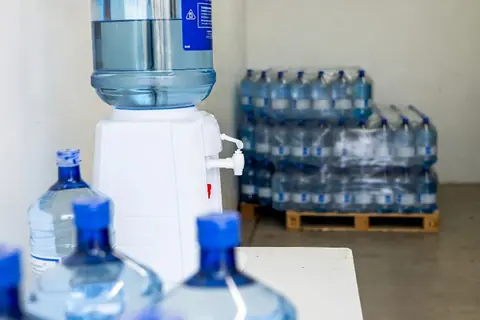
Bottled office water can work where plumbing changes are restricted or the workplace is temporary. Its apparent simplicity still includes delivery coordination, container storage and lifting. Bottleless coolers can reduce those duties at permanent sites, but they require a survey, installation, filters, sanitation and local repair. Review bottleless water cooler service as a maintained system rather than an appliance purchase.
Ask the provider to connect each filter stage to an actual water-quality or equipment-protection goal. Capacity should reflect expected gallons, not only the number of employees. The service record should show filter changes and sanitation, and staff should know the safe first action for a leak, low flow or unusual taste. Clarify who provides parts and whether replacement equipment is available during a longer repair.
Maryland organizations with offices in several counties should request address-level coverage and reporting. A company may use different route days or technicians across the state. Consistent equipment can simplify training, while local delivery totals, filter dates and service calls reveal where a location needs more capacity or a revised schedule.
Compare Maryland water companies on annual price and response
Build a twelve-month comparison that includes rental or equipment, bottles, delivery fees, deposits, minimums, installation, filters, sanitation, repair and removal. Model ordinary attendance and a higher-demand period. The office water delivery cost guide shows why volume and service detail matter more than a headline monthly figure.
Verify the route or technician assigned to every Maryland address. Ask how the provider handles a missed delivery, secure-building access failure, empty inventory, leak or cooler outage. Normal response, escalation contact and charges for after-hours or special visits should be visible before the contract begins. That is the useful meaning of local service reach.
Send the same facts to each finalist: locations, attendance by shift, visitor demand, desired water temperatures, dispenser count, storage, access, plumbing and reporting needs. Require exclusions and renewal language in writing. Use that consistent brief to compare Maryland office water delivery prices and choose with better context.