
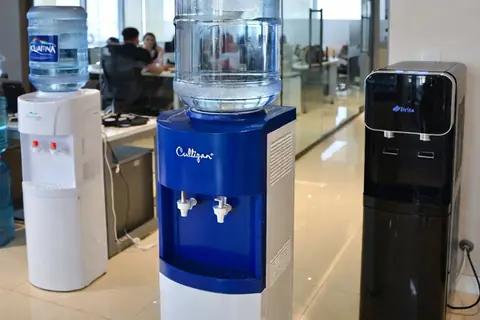
Statewide overview: Massachusetts office water service should be scoped around headcount, building rules, delivery access, plumbing and address-level provider support. Comparing the complete equipment, water, filtration, sanitation and repair plan exposes the real cost of keeping each workplace supplied.
Plan Massachusetts office water around density and access
Office water delivery in Massachusetts serves Boston and Cambridge professional, technology and life-science workplaces, Worcester healthcare and education teams, Springfield-area employers and businesses throughout the coastal and inland markets. A downtown tower, suburban campus and converted industrial building create different access and capacity needs. Start with occupied areas, employees by shift and regular visitor demand rather than one statewide average.
Building management may control loading times, freight elevators, insurance documents and contractor access. Record those rules before requesting bottled delivery or equipment installation. A delayed loading slot can affect route service, while a restricted riser or wall penetration can change bottleless placement. The provider should inspect the exact site instead of assuming that every Massachusetts office can use the same configuration.
Locate dispensers where people can refill without crowding reception, laboratories or clinical work. Ask how quickly chilled water recovers during busy periods and whether hot-water use changes capacity. The daily output of a bottleless cooler provides a useful starting point, but actual use and distance between departments determine the final count.
Define bottled or bottleless service as an ongoing program
Bottled water delivery can fit leased suites, temporary projects and offices where plumbing work is impractical. It requires protected storage, safe lifting and reliable empty pickup. Bottleless water coolers reduce bottle handling at permanent sites, but the service must include installation, filters, sanitation and repair. The office water system options should be compared by operating responsibility, not appearance alone.
For filtration, ask what each stage is designed to address and how rated capacity compares with expected use. A site survey should identify the water source, shutoff, power and any drainage or leak-protection requirements. In a laboratory, clinic or controlled workplace, coordinate installation and maintenance with access procedures so water service does not interfere with regulated or sensitive operations.
Multi-office employers should ask for reporting by address. Bottle quantities, delivery exceptions, filter changes, sanitation visits and repairs reveal whether a Boston location and a western Massachusetts office need different schedules. Standard equipment can simplify staff use, but it should not hide local reach, technician availability or recurring performance problems.
Compare Massachusetts water companies on total service cost
Price twelve months of service, including equipment or rental, bottles, route charges, minimums, deposits, installation, filters, sanitation, repairs and removal. Include building fees or after-hours requirements when they apply. Reviewing the hidden costs of bottled delivery helps buyers account for receiving and storage work as well as supplier invoices.
Confirm the route or technician for every address rather than accepting a broad Massachusetts coverage statement. Ask what occurs after a missed route, failed access attempt, empty inventory, leak or cooling failure. Expected response, escalation and emergency charges should be written. A provider with a clear local process is easier to manage than one offering an undefined promise of support.
Give finalists the same occupancy, locations, temperatures, dispenser features, building rules, storage, plumbing and response expectations. Request separate one-time and recurring charges plus exclusions and renewal terms. With that scope complete, compare Massachusetts office water service prices and judge each offer on the work the office will actually receive.