
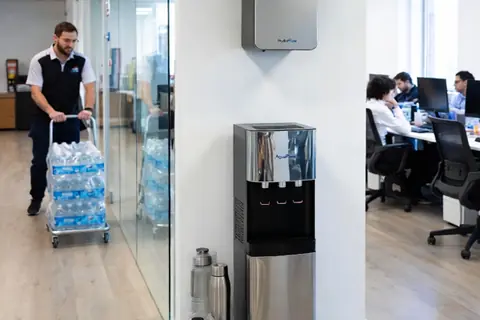
Statewide overview: Michigan office water service should reflect shift schedules, winter delivery access, indoor storage, building plumbing and the route or technician assigned to each location. A complete comparison includes equipment, water or filters, sanitation, repairs and response instead of focusing on one rental rate.
Set Michigan water capacity from shifts and building use
Office water delivery in Michigan supports Detroit-area business and automotive teams, Grand Rapids healthcare and professional offices, Lansing government-related workplaces, Ann Arbor education and technology employers and operations across regional manufacturing markets. Some sites follow a weekday office schedule; others support production shifts, visitors or field employees. Count users by occupied period and department before choosing cooler output or bottle frequency.
A manufacturing office, clinic and multi-floor headquarters can share the same headcount while needing different dispenser placement. Identify the busiest refill window, walking distance and public access. Ask whether chilled recovery and hot-water capacity remain adequate when several people use the unit in succession. The workplace cooler sizing guide can frame these capacity questions.
Bottled programs need a safe receiving route and indoor storage protected from winter temperatures, chemicals and vehicle traffic. Ask how snow or severe weather affects route communication and rescheduling. The provider should recommend enough reserve for a reasonable delay while collecting empties regularly so the office is not used as a bottle warehouse.
Compare bottle handling with bottleless maintenance
Bottled delivery can serve leased, temporary or low-volume Michigan workplaces without changing plumbing. Its recurring work includes receiving, bottle changes, storage and empty pickup. Bottleless water service can reduce that handling at a permanent site, but it requires a survey, water-line installation, filters, sanitation and repair support. Review office water service options by who performs each task throughout the agreement.
A bottleless proposal should explain what the filtration is meant to accomplish and how filter capacity matches use. The site survey should locate the supply line, shutoff, power and any drain or leak-protection requirement. Ask for filter and sanitation records, the expected response for low flow or changed taste and a clear process when a cooler needs parts or replacement.
Michigan organizations with several facilities may benefit from standardized controls and reporting, but local schedules should remain visible. Track deliveries, bottle quantities, filter dates, repair calls and downtime by address. Those records help distinguish a capacity problem from a route or equipment problem and support changes based on evidence rather than complaints alone.
Compare Michigan water companies on reach and annual price
Build a twelve-month cost model. For bottled service, include cooler rental, bottles, delivery fees, minimums, deposits and pickup. For bottleless service, include equipment, installation, plumbing, filters, sanitation and repairs. Include removal, renewal and price-change terms for both. The bottleless versus bottled cost comparison helps organize those categories.
Confirm which route or technician supports Detroit, Grand Rapids, Lansing, Ann Arbor and each retained Michigan market. Ask what happens after a missed delivery, failed access attempt, empty inventory, leak or cooling outage. Notification, escalation, estimated response and any special-visit charge should be explicit. Service reach means an address-level process, not merely a state named on a map.
Send every finalist the same locations, headcount by shift, visitor use, desired temperatures, storage, receiving access, plumbing and support expectations. Require one-time charges, recurring fees, exclusions and service calendars in writing. When the brief is complete, compare Michigan office water delivery prices on the same operating requirement.