
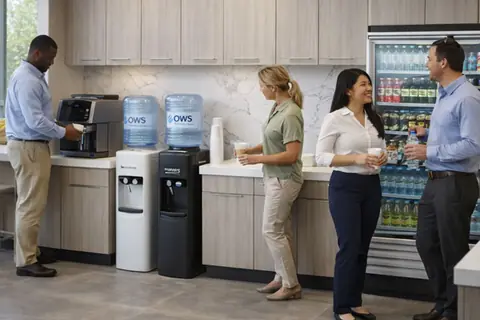
Statewide overview: Minnesota office water service should be designed around workplace demand, winter access, protected storage, plumbing and address-level support. Comparing equipment, delivery or filter schedules, sanitation, repair and contract terms together produces a more reliable view of price.
Plan Minnesota office water for demand and winter access
Office water delivery in Minnesota serves Minneapolis and Saint Paul professional and healthcare workplaces, Rochester medical teams, Duluth regional employers and production, distribution and service businesses across the state. Occupancy can range from compact hybrid offices to continuous operations. Count people by shift, visitors and separated work zones so the service is based on the periods when employees actually refill.
Winter conditions affect receiving and storage. Document where the truck can stop, who maintains the delivery path and how severe-weather route changes are communicated. Full bottles should be moved promptly to indoor storage away from freezing temperatures, chemicals and equipment traffic. Ask for a practical reserve quantity and a rescheduling process. Water delivery reliability is built from those procedures.
Choose cooler locations for convenient use without blocking reception, clinical work or production movement. A large facility may need separate points for staff and guests or for different shifts. Ask about chilled recovery after repeated fills, hot-water demand, accessibility and how the office reports an empty bottle, drip or temperature problem.
Compare delivered bottles with supported bottleless coolers
Bottled water delivery can fit leased offices, temporary locations and buildings where a water connection is impractical. It adds recurring bottle handling, inventory and empty pickup. Bottleless water coolers reduce much of that work at a permanent site, but they require installation, filters, sanitation and local repair. The benefits of switching to bottleless water should be tested against the actual property.
Ask what each filter stage is designed to address and how the provider matched capacity to expected gallons. The survey should locate plumbing, shutoff and electrical access and identify any drainage, leak-protection or building-approval requirement. Require dated filter and sanitation records plus a clear response for a leak, changed taste, low flow or cooler failure.
Organizations with multiple Minnesota locations can standardize basic user features while keeping local service data visible. Track bottles, route exceptions, filter changes, repair calls and downtime by address. One site may need more inventory, another a larger bottleless unit and another a different visit window; statewide purchasing should allow those practical adjustments.
Compare Minnesota water companies on full-year service
Calculate a full year of equipment or rental, bottles, delivery charges, deposits, minimums, installation, filters, sanitation, repairs and removal. Test normal attendance and a higher-demand period. Review the monthly office water delivery cost with internal receiving and storage work included rather than comparing one attractive supplier rate.
Confirm the route or technician serving Minneapolis, Saint Paul, Rochester, Duluth and every retained Minnesota address. Ask what happens when weather delays a route, access fails, inventory runs low or a cooler stops working. Notification, escalation, expected response and travel or emergency fees should be stated before selection. That is more useful than an unqualified promise of statewide coverage.
Provide the same address list, attendance by shift, visitor use, dispenser features, storage, access, plumbing and response requirements to each company. Ask for separate one-time and recurring charges, exclusions, renewal terms and service calendars. With one shared scope, compare Minnesota office water service prices and choose based on the work included.