
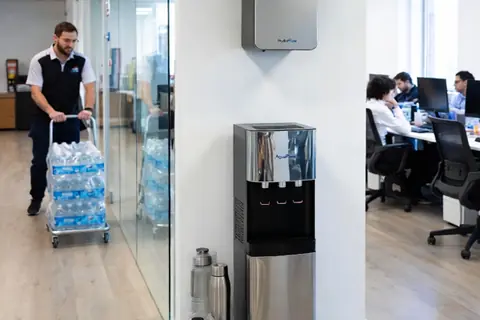
Statewide overview: Tennessee office water service should match workforce schedules, warm-weather demand, building access and address-level provider support. Comparing equipment, delivered water or filters, sanitation, repairs and contract terms together gives buyers a more accurate price.
Plan Tennessee water service around shifts and peak use
Office water delivery in Tennessee serves Nashville healthcare and professional teams, Memphis logistics and business workplaces, Knoxville and Chattanooga employers, hospitality operations and manufacturing support offices. A weekday suite, public clinic and multi-shift facility may share a headcount but not a demand pattern. Count employees by occupied period, guests and work zone before selecting equipment.
Place dispensers where people can refill without crowding reception, clinical areas or production paths. Ask how chilled recovery performs after repeated fills and whether hot-water use affects output. Warm periods and employees moving between indoor and outdoor work may raise demand. The office water cooler sizing guide helps translate refill behavior into capacity questions.
For bottled delivery, document receiving hours, loading distance, security, storage and empty pickup. The Tennessee water bottle company should identify route day, quantity-change cutoff, minimums and reserve guidance. Ask how severe weather, holidays, concerts or other site-specific access changes are handled when they affect a normal visit.
Compare bottled handling with bottleless service duties
Bottled office water can fit temporary, leased and lower-volume workplaces without plumbing changes. It creates recurring receiving, lifting and inventory work. Bottleless water coolers reduce container handling at permanent sites but require survey, installation, filters, sanitation and repairs. Review office water service options according to who performs each task during the agreement.
Ask what each filtration stage is intended to address and how expected gallons affected capacity. The site review should locate the water line, shutoff, outlet and any drainage or leak-protection requirement. Require dated filter and sanitation records plus a defined response for changed taste, low flow, a leak or loss of heating or cooling.
Tennessee employers with several facilities should receive location-level service reporting. Delivery quantities, route exceptions, filter dates, repair calls and downtime reveal whether one office needs more output while another needs a different schedule. Standard equipment can simplify staff use without hiding local route and technician differences.
Compare Tennessee water companies on total annual value
Calculate twelve months of equipment or rental, bottles, delivery charges, deposits, minimums, installation, filters, sanitation, repairs and removal. Test ordinary demand and a busier season or occupancy increase. The office water delivery pricing guide shows why volume, visits and support belong beside the advertised monthly rate.
Confirm which route or technician serves Nashville, Memphis, Knoxville, Chattanooga and every retained Tennessee address. Ask what occurs after a missed route, failed access, empty inventory or equipment outage. Notification, escalation, expected response and special-visit fees should be written. That process defines practical local service reach.
Give each finalist the same locations, shifts, visitors, desired temperatures, dispenser features, storage, access, plumbing and response expectations. Ask for one-time costs, recurring fees, exclusions and renewal terms separately. With that brief aligned, compare Tennessee office water service prices and identify the proposal that includes the complete work.