
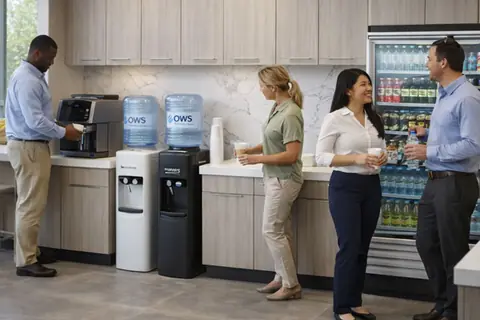
Statewide overview: Texas office water service should account for heat, operating hours, route frequency, building conditions and local technician support. A useful provider comparison prices the cooler, water or filtration, sanitation, repairs and response required at every address.
Plan Texas office water for heat, scale and operating hours
Office water delivery in Texas serves Houston energy and healthcare teams, Dallas and Fort Worth professional and logistics workplaces, Austin technology offices, San Antonio employers and businesses across hundreds of regional markets. A corporate suite, medical campus, warehouse office and field-service operation do not share the same demand. Count users by shift, visitors and separated work areas before selecting capacity.
Long warm periods and employees moving between indoor and outdoor work can sustain chilled-water use. Identify the busiest refill window and place stations where people can reach them without crowding reception, clinical or production paths. Ask how quickly chilled water recovers and whether hot-water demand changes output. Office cooler sizing should follow actual refill patterns.
Bottled programs need shaded indoor storage, safe receiving and regular empty pickup. Route frequency and emergency options may differ between large metros and regional Texas addresses. Ask the water bottle company for route day, minimums, quantity-change cutoff and reserve guidance, plus its response when severe weather or a facility closure interrupts normal service.
Evaluate filtration and bottleless service at each property
Bottled delivery can fit temporary, leased and lower-volume workplaces without plumbing changes. It creates receiving, lifting and inventory duties. Bottleless water coolers reduce container handling at permanent sites but require survey, installation, filters, sanitation and local repair. The bottleless water service guide helps buyers compare the complete supported system.
Ask what every filtration stage is designed to address and how local source conditions, building plumbing and expected gallons affected the recommendation. The site survey should locate supply, shutoff, power and any drainage or leak-protection requirement. Require dated filter and sanitation records and a clear response for changed taste, low flow, a leak or equipment failure.
Texas organizations with offices in several metros should receive performance reports by address. Bottle quantities, route exceptions, filter dates, repairs and downtime show whether a Houston office needs higher output while an El Paso, Lubbock or smaller regional site needs a different visit interval. Standard equipment should simplify management without concealing local reach.
Compare Texas water companies on reach and full-year cost
Calculate twelve months of equipment or rental, bottles, delivery fees, deposits, minimums, installation, filters, sanitation, repairs and removal. Model normal use and a high-demand period. The bottleless versus bottled cost comparison helps facilities teams organize supplier charges and internal handling in the same decision.
Confirm which route or technician serves Houston, San Antonio, Dallas, Austin, Fort Worth and every retained Texas address. Ask what happens after a missed route, failed access, empty inventory, leak or cooler outage. Notification, escalation, expected response and travel or special-visit fees should be written. Statewide coverage is not meaningful without an address-level support plan.
Give each provider the same locations, attendance by shift, visitors, desired temperatures, dispenser features, storage, receiving access, plumbing and response expectations. Ask for one-time charges, recurring fees, exclusions and renewal language separately. Use that complete brief to compare Texas office water service prices and identify the proposal that covers the full operating need.